
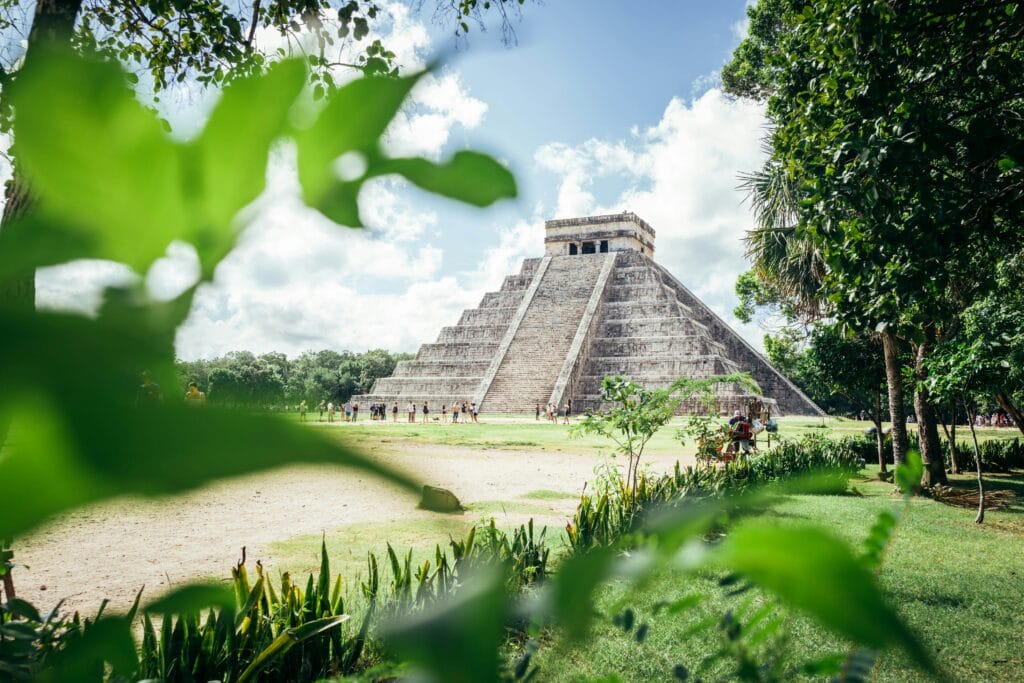
Every year, millions of tourists pour off air-conditioned buses at Chichen Itza, shuffle through the site in the blistering midday sun, take a photo in front of El Castillo, and leave. Done. Box ticked.
That’s not the experience you’re going to have.
With the right approach, Chichen Itza is genuinely one of the most awe-inspiring places in the world — an ancient city where astronomical precision, architectural brilliance, and Maya spiritual life all converge in one extraordinary place. The crowds are real, but they’re also very avoidable. Here’s everything you need to know.
Why Chichen Itza Is Worth It (Despite the Hype)
Let’s be honest: the word “tourist trap” gets thrown around. And at peak hours, with vendors lining every path and tour groups three-deep in front of every structure, it can feel that way.
But Chichen Itza was a major city in the Northern Maya Lowlands for nearly 600 years — flourishing from around 600 CE to 1200 CE. It was likely what the ancient Maya called a Tollan: a mythical great city, a center of power, commerce, and the cosmos. Its scale and state of preservation are genuinely extraordinary.
Come early. Stay curious. It will deliver.
Entrance Fees & Tickets (2025)
| Fee | Cost |
|---|---|
| Federal entrance (INAH) | 271 MXN (~$15 USD) |
| State entrance (Yucatán) | 95 MXN (~$5 USD) |
| Total | ~366 MXN (~$20 USD) |
You pay both fees at the entrance. Prices are subject to change — always check the INAH website before you go. Children under 13 enter free.
Opening hours: 8:00 AM – 5:00 PM daily (last entry at 4:00 PM)
Best Time to Visit Chichen Itza (to Avoid the Crowds)
This is the single most important thing to get right.
Arrive at opening — 8:00 AM. The first 90 minutes are genuinely different from what most visitors experience. The light is beautiful, the temperature is bearable, and you can stand in front of El Castillo in near-silence. By 10:30 AM the tour buses start arriving en masse from Cancún and the Riviera Maya. By noon, it’s a wall of people.
If you genuinely can’t do mornings, after 3:00 PM is your next best option. Many day-trippers from Cancún are already heading back by then, and the golden afternoon light is spectacular for photography.
Best season: November through April. The dry season brings cooler temperatures (low 80s°F / high 20s°C) and dramatically lower humidity. Visiting in July or August means heat, humidity, and afternoon downpours — not impossible, but less enjoyable.
One event worth planning around: the spring and autumn equinoxes (around March 20–21 and September 21–22). At these times, the sun’s angle creates the famous “feathered serpent” shadow descending El Castillo’s staircase — genuinely breathtaking to see. Be warned though: equinox days draw enormous crowds. Go the week before or after to see a less dramatic but still visible version of the effect, with far fewer people.
How to Get to Chichen Itza
From Valladolid (Best Option)
Valladolid is just 40 km away — a 30–40 minute drive. This makes it the ideal base for an early morning visit. You can arrive at the site right at 8:00 AM, explore with the morning to yourself, and be back in Valladolid for a cenote swim and a long lunch before the day-trippers are even getting off their buses.
ADO buses run between Valladolid and Chichen Itza regularly (around 50–70 MXN each way). If you’re driving, the highway toll is about 60 MXN.
From Mérida
About 90 minutes by car or bus. ADO offers frequent direct service from the Mérida bus terminal (~130 MXN). Many travelers do a comfortable day trip.
From Cancún or the Riviera Maya
About 2 to 2.5 hours. Doable as a day trip, but you’ll arrive later and pay more in transport. Staying overnight in Valladolid (a beautiful town in its own right) is a far better experience.
What to See: The Key Structures
El Castillo (Temple of Kukulcan)
The iconic step-pyramid is impossible to miss — and impossible to stop looking at. What’s easy to miss is just how precisely engineered it is. The pyramid has 365 steps total. Each of the four faces has 91 steps; the top platform makes the 365th. It’s a calendar in stone.
The equinox serpent effect is created by the angle of the staircases and the afternoon sun — a shadow that appears to slither down the north face toward the serpent head at the base. The Maya weren’t just building temples; they were encoding time itself into architecture.
(Note: you can no longer climb El Castillo — access was restricted in 2006 after a visitor fell. But honestly, the view from the ground, seeing the whole structure, is the right one anyway.)
The Great Ball Court
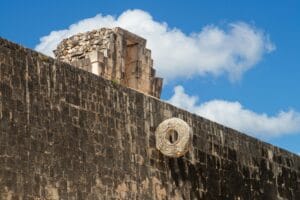
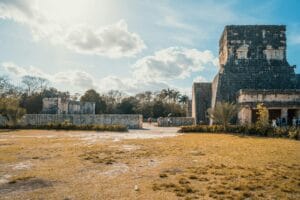
The largest ancient ball court in Mesoamerica, stretching 168 meters long. Stand at one end and whisper — you’ll be clearly heard at the other end, 70 meters away. The acoustics are extraordinary and still not fully understood. The carved reliefs along the walls depict the ritualistic ball game and its connection to life, death, and the movements of the planets.
El Caracol (The Observatory)
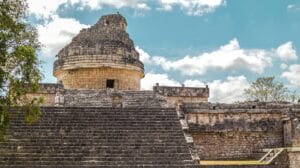
This round, domed structure was built as an astronomical observatory, its windows aligned with the movements of Venus, the Maya’s most sacred planet. It looks almost out of place among the other structures — and that’s because it is. It’s oriented differently from everything else, precisely to track the cosmos.
The Sacred Cenote (Cenote Sagrado)
A short walk north of El Castillo, this large, open sinkhole was considered a portal to the Maya underworld. Jade, gold, incense, pottery — and human remains — were all found in its depths during early 20th century archaeological dredging. You can’t swim in it (and wouldn’t want to — it’s murky and deep), but standing at its edge knowing what lies beneath is a powerful feeling.
The Temple of the Warriors
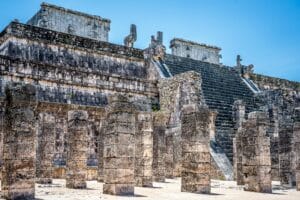
A massive stepped pyramid flanked by hundreds of columns depicting warriors and deities. The Chac Mool statue at the top is one of the most famous images of Mesoamerican art. Notice the similarities to structures at Tula in central Mexico — this is the clearest evidence of the cultural exchange (or conquest, depending on your interpretation) between the Maya and the Toltec.
Las Monjas (The Nunnery)
Often overlooked because it’s slightly further from the main plaza, but worth the walk. The intricate Puuc-style carvings are some of the finest at the site — elaborate mosaic facades of stacked Chaac rain god masks, geometric patterns, and detailed friezes. The Spanish named it “The Nunnery” because the many small rooms reminded them of a convent; it was almost certainly a palace complex for Chichen Itza’s rulers.
Guided vs. Self-Guided
You can absolutely explore Chichen Itza independently with some preparation. But a good guide genuinely transforms the experience.
The astronomical alignments, the political history, the mythology behind each structure, the stories of sacrifice and sovereignty — none of this is visible from the stones alone. Certified guides are available at the entrance (look for the official guide association desk) and typically charge 800–1,200 MXN for a 1.5–2 hour tour for groups of up to 8.
If you’re taking an organized tour from Valladolid or Mérida, check that it includes a guide at the site rather than just transportation.
After Chichen Itza: Cenote Saamal
Here’s what separates a good Chichen Itza day from a great one.
After a morning at the ruins, you need to swim. Not just because you’re sweaty (though you will be), but because cenote swimming in the Yucatán is one of the genuine wonders of travel, and you’re already in the middle of some of the best cenote country on earth.
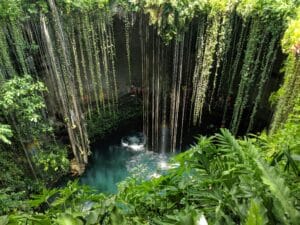
Cenote Saamal, located within Hacienda Selva Maya just outside Valladolid, is our pick for a post-Chichen Itza swim. It’s an open-air cenote with crystal-clear water, a beautiful artificial waterfall, lush jungle surroundings, and far fewer visitors than the famous cenotes at Dzitnup. The hacienda has showers, changing rooms, and a restaurant serving proper Yucatecan food — not the sad buffet you might have gotten on a package tour.
Entry is typically around 150–200 MXN. If you’re based in Valladolid (which you should be), it’s a natural stop on the way back.
What to Bring
- Water — more than you think you need. At least 2 liters per person.
- Wide-brimmed hat — the site has very little shade.
- Biodegradable sunscreen — required near the cenotes; good practice everywhere.
- Comfortable walking shoes — you’ll cover several kilometers on uneven ground.
- Cash — some parking areas and vendors are cash-only. ATMs near the site have unfavorable rates.
- Bug spray — especially if visiting during the rainy season (May–October).
Is It Worth It? Our Honest Take
Yes — without question. Chichen Itza is one of those rare sites where the reality lives up to the billing, if not exceeds it. The key is arriving on your own terms: early, informed, and without the weight of a rushed package tour.
Use Valladolid as your base. Get there at 8:00 AM. Spend 2–3 hours with a guide. Swim in Cenote Saamal on the way back. Eat Cochinita Pibil in the market. That’s the day.
Frequently Asked Questions About Chichen Itza
How much does it cost to enter Chichen Itza in 2025? The total entrance fee is approximately 366 MXN (~$20 USD), which covers both the federal INAH fee (271 MXN) and the state of Yucatán fee (95 MXN). Children under 13 are free. Prices are subject to change — check the INAH website before visiting.
What is the best time to visit Chichen Itza to avoid crowds? Arrive right at opening, 8:00 AM. The first 90 minutes are significantly less crowded before the large tour buses from Cancún arrive around 10:30 AM. Alternatively, visiting after 3:00 PM catches departing crowds. The dry season (November–April) is the best time of year overall.
Can you still climb El Castillo at Chichen Itza? No — climbing El Castillo (the main pyramid) has been prohibited since 2006, following a fatal accident. The site’s other major structures are also off-limits for climbing. Ropes and barriers keep visitors at ground level throughout the site.
How long do you need at Chichen Itza? Budget 2 to 3 hours for a thorough visit with a guide. If you’re self-guided and moving quickly, 90 minutes covers the main structures. The site is large — arriving fresh (morning) and well-hydrated makes a significant difference in how much you enjoy it.
Is Chichen Itza better visited from Cancún or Valladolid? Valladolid is the far better base. It’s just 40 km (25 miles) away — about 35 minutes — compared to 2+ hours from Cancún. Staying in Valladolid lets you arrive at the site at opening time, avoids the expensive and exhausting package-tour experience from the coast, and gives you a genuinely beautiful colonial town to explore before and after.
Is Chichen Itza worth visiting in 2025? Absolutely. Despite the crowds (which you can avoid with good timing), Chichen Itza is one of the most extraordinary archaeological sites in the world. The scale of the architecture, the precision of the astronomical alignments, and the depth of Maya history here are genuinely humbling. Go early, hire a guide, and you’ll understand exactly why it’s a Wonder of the World.
What cenote is closest to Chichen Itza? Several cenotes are within easy reach. Cenote Ik Kil is the most frequently included on package tours — it’s beautiful but can be very crowded. For a better experience, Cenote Saamal (near Valladolid, ~20 minutes away) offers similar beauty with far fewer crowds. Cenotes Xkekén and Samulá at Dzitnup, just 7 km from Valladolid, are also spectacular.
What should I wear to Chichen Itza? Light, breathable clothing in neutral colors. A wide-brimmed hat is essential — shade at the site is minimal. Bring a swimsuit if you’re planning a cenote stop afterward. Comfortable closed-toe walking shoes are recommended over sandals, as the terrain is uneven.
Are there vendors at Chichen Itza? Yes — many. Vendors line the pathways throughout the site selling crafts, clothing, and souvenirs. A polite “no, gracias” is enough. Prices are negotiable, but don’t feel pressured to buy. The vendors are persistent but not aggressive.
Can I visit Chichen Itza without a tour? Yes. You can drive yourself or take an ADO bus from Valladolid or Mérida and explore independently. That said, hiring a certified guide at the entrance significantly enriches the experience — the historical and astronomical context they provide transforms what you’re seeing. It’s well worth the 800–1,200 MXN cost.
great place to visit, thank u for creat this article